Kia EV6 — MOT statistics 2024
The Kia EV6 failed 6.96% of 1,393 first MOT attempts in 2024 ("first-time", excluding retests). Adjusted for the age of the fleet, its initial-failure ratio is 65.4 (100 = expected for its age profile). This car fails its MOT about 35% less often than expected for its age. Small sample — treat with care.
Age-adjusted peer: Lexus IS (index 65.1) — the two published results are 0.3 index points apart.
Kia EV6 common problems: what actually fails the MOT
Tyres are well below the reference at 5.6 per 100 tests, against 8.4 per 100 tests across UK electric vehicles of the same ages.
higher bar = fails more oftenrate per 100 tests

family vs national — matched to UK electric vehicles of the same ages — top component groups, per 100 tests. Legend: This family · National avg. Combined labels: family / national average. A gap here reflects how these vehicles are driven, used and maintained as well as how they were built — an MOT defect is a test outcome, not a breakdown.
Component-group comparison table
| Group | This family | Cases behind it | UK, same ages | Family / national |
|---|---|---|---|---|
| Tyres | 5.6 | 88 | 8.4 | 0.67×0.54–0.82 |
Kia EV6 MOT advisories: what gets flagged
Tyres are highest at 24.1 per 100 tests; Non-component advisories are lowest at 4.0 per 100 tests — the gap is 20.1 per 100 tests.
higher bar = flagged more oftenadvisory items per 100 initial tests

Advisory rates table
| Group | Advisories per 100 |
|---|---|
| Tyres | 24.1 |
| Non-component advisories | 4 |
Advisories are wear the tester noted but didn't fail — what will need money soon.
Tyres, brakes and suspension: Kia EV6 against cars of the same age
| Age | Part | Kia EV6 | Same age, petrol and diesel | Difference |
|---|---|---|---|---|
| 3 years | Tyres | 4.41 | 4.17 | 0.24 |
| 3 years | Brakes | 0.36 | 1.77 | -1.41 |
| 3 years | Suspension | 0 | 0.63 | -0.63 |
Failing items per 100 initial tests, 2019-2024. The comparison group is every petrol or diesel car tested at the same age, so weight and drivetrain show up rather than fleet age.
Adjusted for how much these are actually driven
The headline index adjusts for the fleet's age. Wear, though, follows mileage: a three-year-old taxi and a three-year-old garage queen sit in the same age band. These two rows compare every car with vehicles of the same age, and then with vehicles of the same age and the same annual mileage, 2019-2024, on 1,522 tests. Both stand on the six-year corpus so they are measured on identical data — compare them with each other, not with the headline index above, which is measured on 2024 alone.
| Standardised for | Index | Reading |
|---|---|---|
| Age only | 62.0 | fails less often than expected |
| Age and annual mileage | 56.9 | fails less often than vehicles driven as much |
| Share doing under 3,000 miles a year | 3.5% | a normal spread of use |
Mileage matters here: matching on how much these are driven moves the figure by 5.1 points — this fleet works harder than the vehicles it is measured against, so the age-only view penalises it — but it does not change which side of normal the car sits on. One limit to keep in mind: mileage is partly a result of how often a car breaks down — one that spends weeks in the workshop covers fewer miles — so the mileage-matched figure can understate a real weakness. Tests with no usable odometer reading are left out of it.
How the Kia EV6 compares with cars of its own age and size
Not against the whole fleet — against cars of the same size class tested at the same age, 2019-2024.
| Age | Kia EV6 | Same class, same age | Difference | Tests |
|---|---|---|---|---|
| 3 years | 7.63% | 12.56% | -4.94 pp | 839 |
Raw first-time failure rates within each age, so fleet age cannot flatter either side. A positive difference means this model fails more often than its own class at that age.
How does the Kia EV6 perform as it gets older?
The EV6 at age 3 is well below the reference at 7.6%, against 12.4% for all vehicles of the same age.
higher = larger sharecompare shares in percentage points
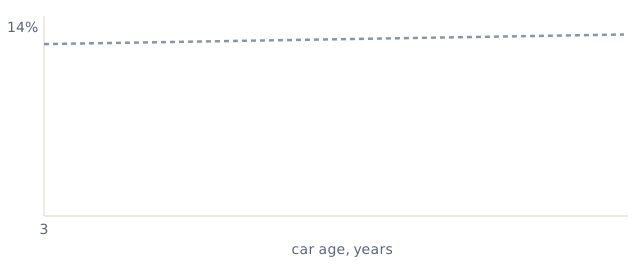
Chart axes: car age, years · failure-rate scale 0–14%.
Takeaway: solid line: this family; dashed: all cars.
Data table
| Age | Kia EV6 | All vehicles | Gap |
|---|---|---|---|
| 3 | 7.6% | 12.4% | -4.8 pp |
Is a Kia EV6 ULEZ compliant?
The share of classifiable 2024 Kia EV6 MOT tests likely ULEZ compliant by first-registration date is 100.0%.
Based on 1,393 classifiable initial MOT tests. This describes the tested fleet, not a specific car. MOT data do not record Euro class, so likely compliance is inferred from fuel and first-registration date. For the only authoritative answer, check the registration with TfL's official ULEZ checker.
higher = larger share likely compliantinferred from fuel and first-registration date; not a recorded Euro class
| Vehicle age at test | Likely ULEZ-compliant share | Tests |
|---|---|---|
| Under 3 years | 100.0% Check a registration with TfL | n = 554 |
| 3–5 years | 100.0% Check a registration with TfL | n = 839 |
| 6–7 years | Suppressed — sample below publication threshold Check a registration with TfL | n = 0 |
| 8 years | Suppressed — sample below publication threshold Check a registration with TfL | n = 0 |
| 9 years | Suppressed — sample below publication threshold Check a registration with TfL | n = 0 |
| 10–14 years | Suppressed — sample below publication threshold Check a registration with TfL | n = 0 |
| 15–17 years | Suppressed — sample below publication threshold Check a registration with TfL | n = 0 |
| 18 years | Suppressed — sample below publication threshold Check a registration with TfL | n = 0 |
| 19 years | Suppressed — sample below publication threshold Check a registration with TfL | n = 0 |
| 20+ years | Suppressed — sample below publication threshold Check a registration with TfL | n = 0 |
How dangerous are Kia EV6 MOT failures?
Major defects are well below the reference at 4.0 per 100 tests, against 52.8 per 100 tests nationally.
higher bar = fails more oftenrate per 100 tests

Severity table
| Severity | This family /100 | National /100 | Family / national |
|---|---|---|---|
| Minor | 1.92 | 14.22 | 0.14× |
| Major | 4.03 | 52.75 | 0.08× |
| Dangerous | 3.58 | 11.15 | 0.32× |
Chart values: Minor 1.9 · Major 4.0 · Dangerous 3.6.
Per 100 tests on this family. National average: Minor 14.2 · Major 52.8 · Dangerous 11.2 per 100.
Does the month of a Kia EV6 MOT matter?
Feb is highest at 10.7%; Jun is lowest at 1.6% — the gap is 9.1 percentage points.
higher = larger sharecompare shares in percentage points
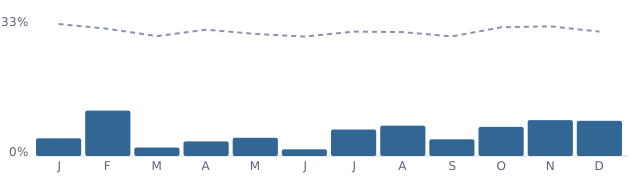
Chart scale: 0%–33%.
bars: Kia EV6 · dashed: all class-4 cars
Month-by-month table
| Month | Kia EV6 | All vehicles | Gap |
|---|---|---|---|
| Jan | 4.17% | 31.12% | -27.0 pp |
| Feb | 10.71% | 29.99% | -19.3 pp |
| Mar | 2% | 28.26% | -26.3 pp |
| Apr | 3.45% | 29.78% | -26.3 pp |
| May | 4.29% | 28.79% | -24.5 pp |
| Jun | 1.59% | 28.15% | -26.6 pp |
| Jul | 6.25% | 29.33% | -23.1 pp |
| Aug | 7.14% | 29.2% | -22.1 pp |
| Sep | 3.94% | 28.19% | -24.3 pp |
| Oct | 6.85% | 30.34% | -23.5 pp |
| Nov | 8.47% | 30.58% | -22.1 pp |
| Dec | 8.3% | 29.33% | -21.0 pp |
Takeaway: the spread between best and worst month is 9.1 percentage points — noticeable seasonality. Seasonality partly reflects registration-date clustering, not weather.
Before reading the shape: most of it is not about cars. Britain changes its registration plates twice a year, and 18.9% of these cars were first registered in March with another17.1% in September — 36% in two months against the 17% an even spread would give. An MOT falls due three years after first registration, so the buying calendar becomes the testing calendar. That shapes how many cars are tested each month — not how often they fail: the busiest months here are not the worst ones, so read the failure line on its own and the volume behind it separately.
Kia EV6 average mileage by age
At age 3, the middle half of EV6s runs from 17,511 miles to 34,501 miles, against 24,265 miles as the median.
further right = more milesmedian is the typical car; band is p25–p75
Does high mileage mean more Kia EV6 MOT failures at the same age?
Within the same age group, split by odometer (2024 MOTs), so this separates wear from age: at ages 3–5, 7.2% of those with under 40,000 miles failed first time versus 9.1% of those with 40,000–70,000 miles.No clear mileage gap inside this age group, among cars still being tested.

| Age | Odometer | % failing | 95% interval | Tests |
|---|---|---|---|---|
| 3–5 | <40k miles | 7.2% | 5.5–9.3% | 708 |
| 3–5 | 40-70k miles | 9.1% | 5–15.9% | 110 (rough estimate) |
line: median · band: middle half of the fleet (p25–p75)
Mileage by age (p25 / median / p75)
| Age | p25 | Median | p75 | Tests |
|---|---|---|---|---|
| 3 | 17,511 | 24,265 | 34,501 | 839 |
A typical 3-year-old EV6 has ~24,265 miles on the clock. Much more — ask why; much less — check for gaps in the MOT history.
Where in Britain the Kia EV6 fails its MOT most
Too few tests in any single postcode area to name one, so this is the wider picture across 1,563 tests, 2019-2024.
| Part of Britain | % failing | Tests |
|---|---|---|
| Midlands | 7.76% | 348 |
| Northern England | 6.41% | 156 |
| Southern England | 6.11% | 949 |
Raw pass/fail rates, not age-adjusted: fleets differ by region. England is split north of Sheffield, between Sheffield and Oxford, and south of it.
Kia EV6 faults that come together
| Group A | Group B | Together | Lift |
|---|---|---|---|
| Tyres | Visibility | 6 | too few (rough estimate) |
Defects in «Tyres» and «Visibility» were seen together in 6 tests (21 pairs compared).
Lift = how many times more often both groups appear on the same test than if independent. A pair is listed from 5 tests with both faults; the lift is shown from 20, and called above chance only when its 95% interval excludes 1 (see rough estimates).
Kia EV6 rust problems: where they corrode
Salt-belt exposure is well below the reference at 17th percentile, against 50th percentile as the middle of published models.
higher = larger sharecompare shares in percentage points
This Kia EV6 has too few tests to judge for corrosion once age is held constant, and its owners live in areas that are gentler than most for the models we publish.
Corrosion is the one failure mode that is as much about geography as about the car. We keep the two apart on purpose: a model can look rusty simply because it is popular in Scotland, and a model can look clean simply because it is bought in Surrey. Blending them into a single score would hide which of the two is doing the work.
Exposure is this model's tests weighted by an area corrosion index built from frost days, salt load and distance to the coast — the composite validated at r = 0.42 against corrosion defects we actually record. It is published as a rank, not a raw score, because every mainstream model skews towards low-corrosion areas for the simple reason that most of Britain's cars are in the south. Susceptibility is standardised to the national age profile, so an old fleet does not get labelled a rusty model.
What will fail next on a Kia EV6?
Tyres after a passed at age <3 stand out at 1.8%.
higher = more likelypercentage is the observed transition probability
| Age | Last test | Most likely next failures | Cars tracked |
|---|---|---|---|
| <3 | passed | Tyres 1.8% | 282 (rough estimate) |
The same chains, cut differently: given a car's age and how its last test went, which component most often causes trouble at the following one.
The pattern that repeats across every family: a failure at one test roughly doubles the chance of a failure on the same component at the next one, and an advisory sits about half-way between a clean pass and a failure. Age bands in years; probabilities are per car, not per defect item.
Kia EV6 safety recalls and how to check yours
DVSA recall campaigns stand out at 8.
bigger number = more recorded casescompare like-for-like scope, not sample size alone
recall campaigns launched per year

| Reference | Launched | Vehicles | Concern |
|---|---|---|---|
R/2026/139 | 24/04/2026 | 302 | Kia Cluster Malfunction Recall |
R/2024/197 | 20/05/2024 | 2,210 | Kia EV6 Intergrated Charge Control Unit Recall |
R/2024/197 | 20/05/2024 | 1,133 | Kia EV6 Intergrated Charge Control Unit Recall |
R/2024/197 | 20/05/2024 | 1,469 | Kia EV6 Intergrated Charge Control Unit Recall |
R/2024/197 | 20/05/2024 | 7,300 | Kia EV6 Intergrated Charge Control Unit Recall |
All 8 campaigns
| Reference | Launched | Build dates | Vehicles | Concern |
|---|---|---|---|---|
R/2026/139 | 24/04/2026 | 01/07/2025 – 17/12/2025 | 302 | Kia Cluster Malfunction Recall |
R/2024/197 | 20/05/2024 | 20/04/2021 – 28/02/2024 | 2,210 | Kia EV6 Intergrated Charge Control Unit Recall |
R/2024/197 | 20/05/2024 | 20/04/2021 – 28/02/2024 | 1,133 | Kia EV6 Intergrated Charge Control Unit Recall |
R/2024/197 | 20/05/2024 | 20/04/2021 – 28/02/2024 | 1,469 | Kia EV6 Intergrated Charge Control Unit Recall |
R/2024/197 | 20/05/2024 | 20/04/2021 – 28/02/2024 | 7,300 | Kia EV6 Intergrated Charge Control Unit Recall |
R/2024/197 | 20/05/2024 | 20/04/2021 – 28/02/2024 | 4,499 | Kia EV6 Intergrated Charge Control Unit Recall |
R/2024/163 | 11/04/2024 | 26/01/2023 – 10/04/2023 | 236 | Kia EV6 and Niro SG2 Driveshaft Recall |
R/2022/173 | 30/05/2022 | 17/07/2021 – 02/05/2022 | 3,805 | SHIFTER CONTROL UNIT (SCU) UPGRADE. |
DVSA lists 8 safety recall campaigns for the Kia EV6, covering roughly 20,954 vehicles in total. A recall is the manufacturer fixing a fault for free, so an open recall on your car costs nothing to clear.
Counter-intuitive, and measured on our own data: across the 25 families published here, more recalls go with a lower MOT Risk Index (r = −0.52). Heavily recalled models are not worse cars in the test bay — an active manufacturer removes the fault before it becomes an MOT failure.
Check whether a specific car has an outstanding recall — free, by registration — at DVSA's recall service. Source: DVSA vehicle safety recalls (check-vehicle-recalls.service.gov.uk), OGL.
Kia EV6 technical service bulletins: what dealers are told
US market, Kia EV6, model year 2022 only. A count of bulletins, not a UK failure rate.
NHTSA manufacturer communications are 77.
bigger number = more recorded dealer communicationsnot affected vehicles or confirmed faults
These are the issues the manufacturer fixes quietly: service communications sent to dealers without a public recall campaign. They show what the service network has been told even when the issue never became news.
United States · NHTSA manufacturer communications
| Communication year | Bulletins | Leading subjects across all years |
|---|---|---|
| 2022 | 23 |
|
| 2023 | 27 | |
| 2024 | 12 | |
| 2025 | 4 | |
| 2026 | 11 |
Caveat worth stating plainly: this is NHTSA data about US-specification cars. British cars sold under the same name often use different gearboxes, engines and equipment, so a bulletin may describe a component that was never fitted here. The file counts dealer communications, not affected vehicles or confirmed failures, and it cannot tell you whether an individual UK car has the issue. A communication can carry more than one subject tag, so topic counts do not have to add up to the total. Source: NHTSA Manufacturer Communications API (US-market vehicles; queried model years 2015-2022). Licence: U.S. Government work / public domain · retrieved 2026-09-25.
Kia EV6 owner complaints: what goes wrong
US market, Kia EV6, model year 2022 only. A count of owner complaints, not a UK failure rate; NHTSA has no UK denominator.
Lamps & electrical are highest at 220; Visibility is lowest at 4 — the gap is 216.
bigger number = more recorded casescompare like-for-like scope, not sample size alone
| Component | Complaints | Share | MOT fail items per 100 | MOT rank | Agreement |
|---|---|---|---|---|---|
| Lamps & electrical | 220 | 79.4% | not in top 6 | — | complained about, rarely an MOT failure |
| Transmission (not MOT-tested) | 41 | 14.8% | not in top 6 | — | complained about, rarely an MOT failure |
| Engine (not MOT-tested) | 14 | 5.1% | not in top 6 | — | complained about, rarely an MOT failure |
| Brakes | 13 | 4.7% | not in top 6 | — | complained about, rarely an MOT failure |
| Body & structure | 10 | 3.6% | not in top 6 | — | complained about, rarely an MOT failure |
| Visibility | 4 | 1.4% | not in top 6 | — | complained about, rarely an MOT failure |
Two different populations answering two different questions: the MOT records what an inspector can measure once a year, the complaint file records what annoyed or frightened an owner on the road. A component high in one column and absent from the other is the interesting case — driver-assistance and electronics dominate complaints while almost never appearing as an MOT failure item.
What the reports actually say
The taillight came loose and every time i take it in to get checked or fixed at the dealer they ignore me, so i went in and tightened my self. there were 4 nuts already off and inside my trunk and there was no loctite on the bolts holding the light on. now the lamp is leaking water into the trunk and the tail light has water inside of it.
ICCU electrical system failed while driving (~1mi from house). Warning messages popped up and caused me to pull over and drive back to house under reduced speed. Kia told me car was not safe to drive and to tow car for repair under warranty. ICCU failure was confirmed by service provider and repaired after 2 weeks (diagnosis, part order, and replacement).
US owners have filed 277 complaints about the equivalent Kia EV6 to the National Highway Traffic Safety Administration, including 11 that mention a crash, 0 a fire and 6 an injury. These are owner reports, not verified findings — but they are the only large public record of what drivers themselves notice, and they cover the years between MOT tests.
Caveat worth stating plainly: US-specification cars, self-selected reporters, no denominator — complaint counts scale with how many cars were sold there and how motivated owners are to file. The mechanical gap matters as much as the statistical one: American cars of the same name often carry different gearboxes, engines and equipment — automatics where Britain buys manuals — so a drivetrain complaint filed in Ohio may describe a part that was never fitted here. Read the ranking inside a model, not between models, and treat drivetrain entries with particular caution. Source: NHTSA ODI consumer complaints (US market, public domain) — US-spec vehicles, indicative only.
Kia EV6 MOT: quick answers
Kia EV6 MOT Risk Index is well below the reference at 65.4, against 100 for a car with the same age profile.
below 100 is betterabove 100 is worse100 = normal for this model at that age
- What is the Kia EV6 first-time MOT pass rate?
- 93.04% of first attempts passed in 2024 (1,393 tests). This is the first-time figure: retests after repair are excluded. Basis: first-time, excluding retests.
- Why does this number differ from other sites?
- Other sites often report a pass rate that includes retests or counts all attempts. Our 6.96% figure is the first-time initial failure rate, using 1,393 primary tests as the denominator (first-time, excluding retests). The age-adjusted MOT initial-failure ratio 65.4 is shown separately because raw rates compare fleet age as well as cars.
Compare the Kia EV6 with other cars
Mazda CX-30 is highest at 66.0; BMW Z4 is lowest at 64.7 — the gap is 1.3 points.
below 100 is betterabove 100 is worse100 = normal for this model at that age
Same brand
All Kia MOT statisticsKia Stonic MOT statsKia Stinger MOT stats
Similar risk
Lexus IS (index 65.1)Mazda CX-30 (index 66.0)BMW Z4 (index 64.7)
Same size class
how Mercedes-Benz G-Class compareshow Caterham Seven compareshow Audi RS4 compares
By failure group
Kia EV6 tyres failuresKia EV6 visibility failures
Data details & how to cite
Scope: class-4 vehicles (cars), initial tests only, outcomes pass / fail / fixed-on-the-spot at the station (PRS counts towards the failure rate — the defect was present at arrival). Index = observed initial failures ÷ failures expected for this fleet's exact age profile, ×100; margin of error is a 95% confidence interval. Covers ALL generations together — a 3-year-old and a 15-year-old are very different cars; a generation split is on the roadmap. Dataset release dataset_release_id=dvsa-2024-v2, frozen baseline; headline claim_id=family-stats:kia-ev6:dvsa-2024-v2. Full method: methodology.
Cite: MOT Risk Index (2026). Kia EV6 MOT statistics 2024 (data release dvsa-2024-v2; downloadable dataset motriskindex-families-2024-v5, doi:10.5281/zenodo.22975051). https://motriskindex.co.uk/cars/kia-ev6/ · Published 2026-07-30.